
Georgia Current Owner Record Card
The assessor's property card is where most owner-of-record lookups begin in Georgia. Its owner label varies by county. A card may read Owner, Owner Name, Taxpayer, or some other local term, so read the field as printed instead of expecting one statewide format. Dates and addresses often sit near the name. Each carries a different meaning. Treating them alike is the fastest way to misread a property record.
| Owner name | Person or entity shown under the county's owner, owner-name, or taxpayer field. |
|---|---|
| Mailing address | Address used for assessment and tax notices; it can be a care-of or out-of-county address. |
| Situs address | Physical property location used to identify the parcel. |
| Parcel ID | County-specific map, parcel, property, or account key; keep its full format. |
| Last sale or transfer | Shown by some county systems, but not a uniform or guaranteed current-owner date. |
| Deed reference | Book, page, or instrument locator where the card provides one. |
These fields describe the county card, not the home's occupant. The mailing address may be a representative's. A card can also omit a deed reference. Note the source name and data year with the owner field. "Current" only means current on that record's displayed date. No statewide rule makes every county refresh its property records on the same day.
Georgia Owner Roll Timing Varies
Georgia sets no statewide clock for this. Timing is a local matter. After a recorded sale, each county updates its property card and digest on its own schedule, and a notice can carry an annual tax year while the Clerk of Superior Court records instruments as they arrive. The card's data date and the deed's recording date are separate timestamps.
A new deed can outrun the annual roll. That gap makes the tax-card name a discovery clue and the latest matching conveyance the stronger date check. The interval varies by county. No single update schedule spans all 159 systems. Label Georgia property records by source and date instead of compressing them into an "updated recently" claim.
Recent transfers need three dates. Note the card's tax year, the instrument's recording date, and any update stamp the county prints. If the card shows no refresh stamp, treat the timing as unknown and confirm through the Clerk of Superior Court. An annual notice is not a live transaction feed. A current-owner lookup works best when each source keeps its own date.
Tax roll versus deed. A county roll can lag a recorded conveyance. For a timely owner check, compare the card with the newest deed that matches the parcel's county and legal description.
Confirm Georgia Owner Data by Deed
The county card identifies the parcel. The deed confirms the owner. The GSCCCA Real Estate name search offers statewide deed-index discovery by party name and county, while the county Clerk of Superior Court remains the official custodian of the recorded instrument. The search page displays its name-search entry form.
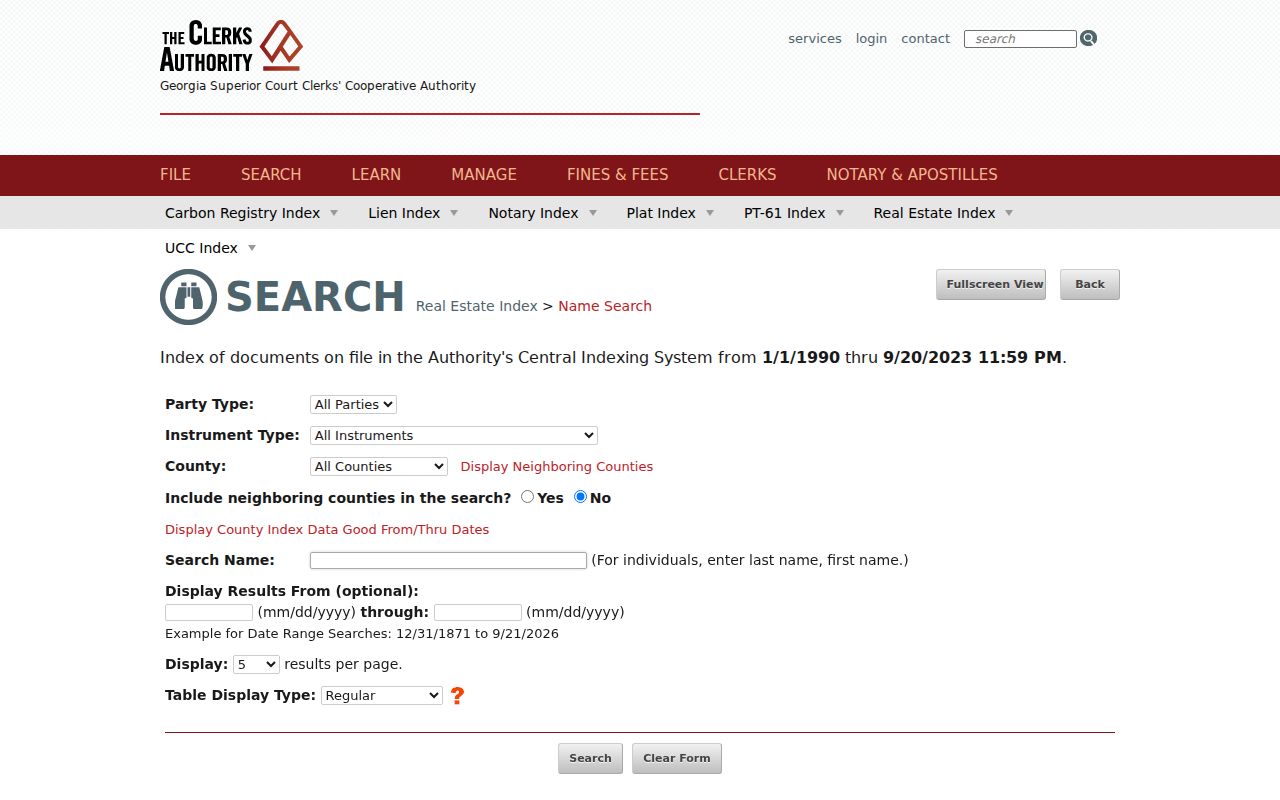
A result is only a lead. Open the record itself by book and page. Then compare parties, capacity, legal description, and recording date with the parcel card before treating both as the same property.
- Copy the county, exact owner name and capacity, parcel ID, and legal description from the assessor card.
- Search the owner name and county in the GSCCCA Real Estate Index, using a date range suited to the recorded transfer.
- Read the latest matching instrument reference and open its image if the record is available to the account.
- Compare the grantee, legal description, county, and recording date; ask the county clerk for a certified copy when needed.
The index summary is only a locator. Image access depends on county participation and account level. For certified copies, the clerk can explain access by mail, at the counter, or through a local portal. The Georgia owner-finding method starts from an address, while the Georgia deed-records page covers index modes and copy access in depth.
Georgia Current Owner Filing Alerts Need Review
FANS is a free, voluntary GSCCCA service. It sends alerts when selected real-estate or personal-property documents are filed, indexed, and transmitted to GSCCCA and match a user's criteria. An alert can flag a new instrument fast. It is not a title report, though, and it does not replace review of the parcel's complete record. County transmission and indexing set the limits of what can trigger an alert. The official FANS service page provides signup information.
Georgia Property Owner Address Fields
Situs and mailing addresses do different jobs. The situs address identifies the physical parcel for the assessor and for the GIS map. The mailing address receives tax and assessment notices. One owner can route many parcels to a single mailing address. A single parcel can carry a care-of line. Neither field proves who lives at the property.
Postal labels will not settle jurisdiction either. In Georgia, a postal city can cross municipal or county lines, and one city can use more than one ZIP. Keep the county, municipality, and postal label distinct by relying on the parcel location and legal description. For contact about a property matter, use only the public notice address and respect any protected-address program.
- Owner of record
- The party the assessor roll names for the parcel; confirm with the recorded instrument.
- Assessment roll
- The county property-tax record for a stated year, with its own card and notice date.
- Situs
- The physical location of the land or building.
- Mailing address
- The correspondence address for the tax record, which may be different from the situs.
- Recording lag
- The time between a document entering the clerk's record and a county card reflecting that data; no statewide interval is promised.
Georgia LLC Names on the Current Roll
Assessor cards in Georgia often list an LLC, corporation, trust, or estate instead of a person. Copy the name exactly. Note the capacity too. To see who stands behind a corporate name, run it through the Georgia Secretary of State Corporations Division's Business Search, which offers lookups by business name, control number, registered agent, officer, and designated agent. An entity file can confirm the legal name on a property record. It still cannot prove that the entity owns the parcel in question.
The official Georgia Business Search page displays the portal's match options for narrowing results.
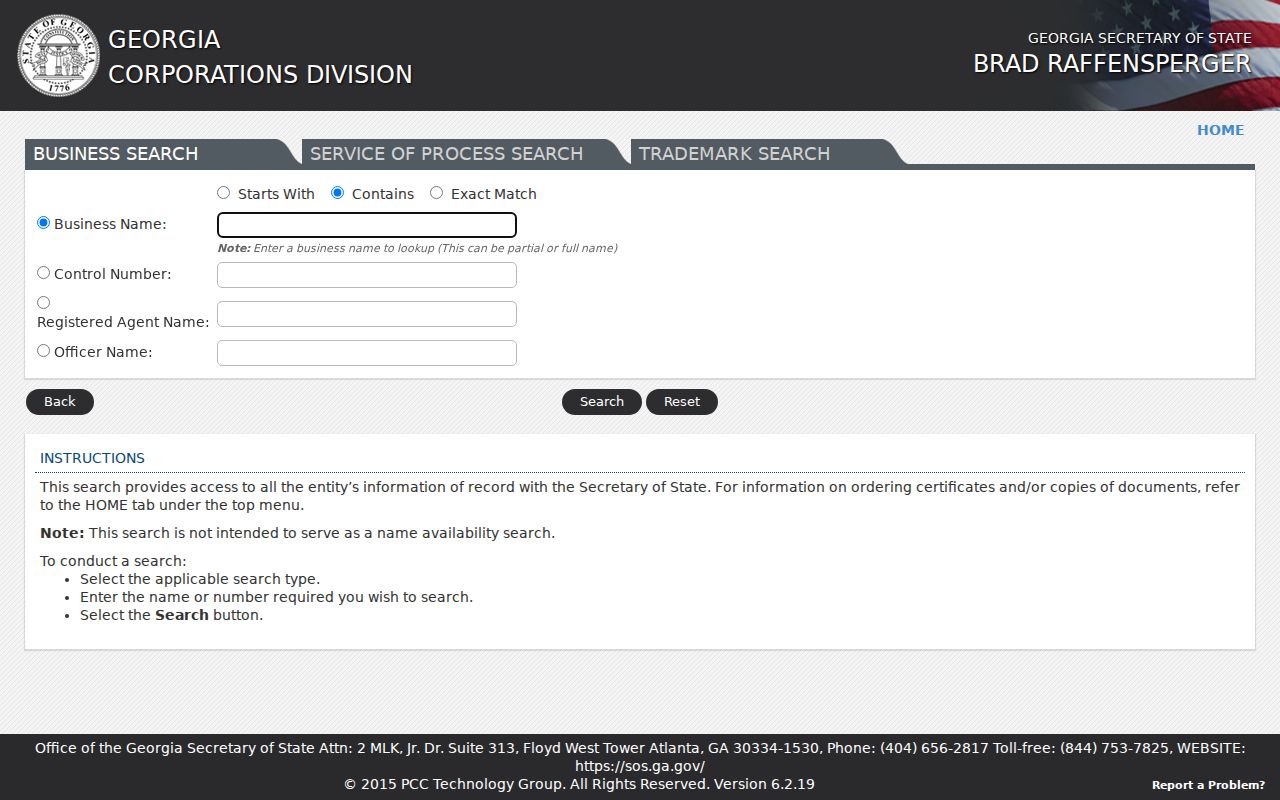
Tie any business record back to the recorded deed. A similar name alone proves little. A registered agent accepts legal notices for an entity. That role establishes neither an ownership share nor a personal residence. Trusts complicate things further. A trust may appear under a trustee's name or a shortened form. An estate may show a fiduciary instead of the decedent. The deed's vesting language and legal description are what connect a party, in a stated capacity, to the property record. Match those elements before drawing any conclusion about who holds title.
| SOS Search Field | What It Finds | What It Does Not Prove |
|---|---|---|
| Business name | Starts-with, contains, or exact entity match | That the entity owns a parcel |
| Control number | The entity's state filing record | Its current owner-of-record status |
| Registered agent, officer, or designated agent | People named in the business filing | Parcel title or personal occupancy |
Georgia Homestead Is Not an Owner Field
A homestead flag signals an exemption. It is not an ownership field. DOR states that the homeowner generally must own and occupy the property as a legal residence on January 1 of that tax year. That is the qualifying condition. The exemption stays on the roll as a year-specific fact. No one may live there today. The flag never replaces the assessor's owner label or the deed's vesting language.
Local rules vary across Georgia. Homestead filing terms and county-level exemptions can differ. Floating or base-year rules affect taxable value for some parcels. The DOR homestead guidance lays out the state framework. It points to local tax offices for the details. Treat the flag as a tax-record fact for its listed year only. Never use it to guess who lives at the property now. Never use it to expose an address.
Georgia Current Owner Record Access
Begin with the DOR county property-record directory. Then confirm the assessor link actually serves the jurisdiction where the land sits. DOR does not run the local sites, and it notes that some counties publish no property records online at all. If the current owner field is missing, call or visit the Board of Tax Assessors and ask for the existing card, assessment notice, or parcel record. The county clerk can supply the recorded instrument.
A written request works best with specifics. Include the parcel ID, situs address, tax year, owner field, and the format you want. Under the Georgia Open Records Act, agencies generally respond within three business days, provide a production estimate, or explain an exemption; they need not create a new record. The Attorney General's request guidance explains how to describe the record you need. Search and redaction labor is generally free for the first 15 minutes. Copies generally run up to $0.25 per page, subject to the custodian's current schedule.
Counties accept requests through different channels: online forms, phone, counter, mail, or email. Always use the contact the assessor or clerk actually lists. Georgia has no statewide office that can answer for every local parcel.
Reach a Georgia Property Owner Safely
For any property matter, write to the public mailing address on the county record. Never assume the situs address is a residence. Georgia's Safe at Home program gives eligible survivors and at-risk participants a designated address. It also provides mail forwarding and a sealed voter address. VoteSafe separately shields qualifying voter residence addresses. A public-record lookup must never be used to reverse those protections. It must never piece together a protected home location.
The Secretary of State's Safe at Home information describes how the program operates. Its contact details and eligibility steps stay with that office. Keep property research narrow. Pull only the fields needed to identify the parcel. Note the source date. Route questions to the custodian of the record. Do not copy extra personal identifiers or use an owner's address to harass or intimidate anyone.