
Georgia Deed Records and Their Instruments
Deeds are just one class of land instrument on file. Each county's Clerk of Superior Court records deeds, security deeds, liens, and releases. Plats and related paperwork go through the same office. The index entry usually lists the parties, the property's location, the instrument type, and the date. A book and page completes the row. To read the legal description and any easements or reservations, you need the recorded image itself. The same image holds the actual terms. An index row only sketches the deal. The full instrument tells the story of the parcel.
| Deed Type | What It Does | Common Use |
|---|---|---|
| Conveyance or warranty deed | Records an interest transferred in the instrument; read its operative terms. | Review a transfer tied to a sale or other conveyance. |
| Quitclaim deed | Transfers whatever interest the grantor has, if any. | May appear in a family or title-cleanup transfer. |
| Executor or administrator deed | Records an estate representative's transfer. | Match it to the county Probate Court file and authority. |
| Security deed / deed to secure debt | Records a security interest in land, not an ordinary sale. | Follow assignments and recorded cancellation or release. |
| Tax deed or deed under power | Records a transfer tied to a tax sale or exercise of a power. | Check the related proceedings and later instruments. |
A deed and an encumbrance are separate entries, even when both touch the same parcel. A security deed or lien stays on the books. It remains until a release, satisfaction, cancellation, or other resolution is recorded. An old index hit alone says nothing about current status. For party and county search routes, see GSCCCA's Real Estate Index. There is also a separate lien-name form. It carries party, instrument, county, and date controls for related encumbrance records.
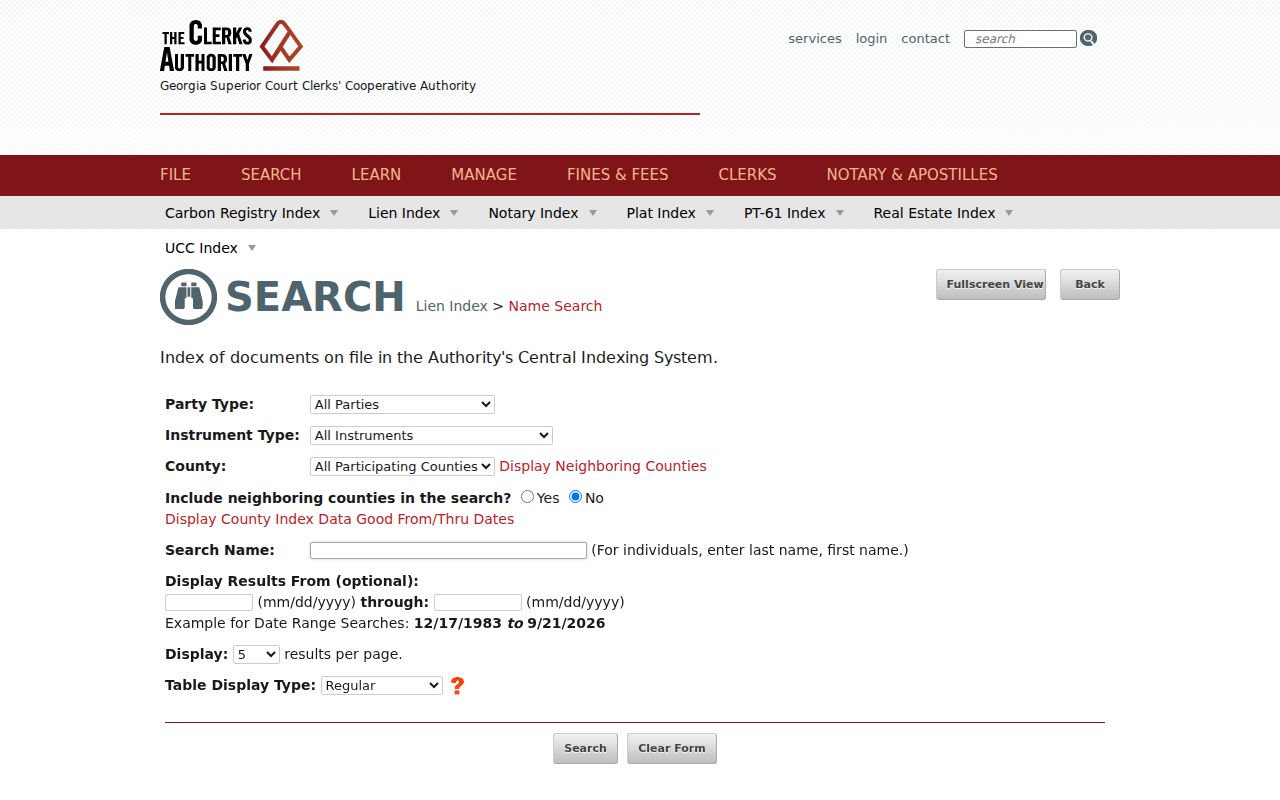
The lien index is a locator. Confirm the instrument and any recorded release with the county Clerk.
Georgia Deed Records on GSCCCA
The statewide name form narrows a deed search by party role, instrument type, county, nearby counties, and date range. Individuals go in last name first; a business or trust uses its full name string. The form also links to county "good from/thru" coverage dates. Start with one county when you know it. Add neighboring counties when the parcel or ownership history may cross a county line.
| Field | Type | Required | Search note |
|---|---|---|---|
| Party Type | Dropdown | No | Filters a party role; the live page does not publish exact choices in the text extract. |
| Instrument Type | Dropdown | No | Narrow to available deed or related instrument categories. |
| County | Dropdown | No | Select where the land was recorded; county scope matters. |
| Neighboring Counties | Yes / No control | No | Useful for a cross-county ownership trail. |
| Search Name | Text | For name search | Individuals: last name, first name; entities: name string. |
| From / Through | Date pair | No | Enter recording-date range in month/day/year format. |
| County coverage dates | Link / notice | No | Check before treating an older blank search as a gap. |
The GSCCCA name search form exposes these controls. Its result row is only a locator, so read the deed image before relying on the instrument description.
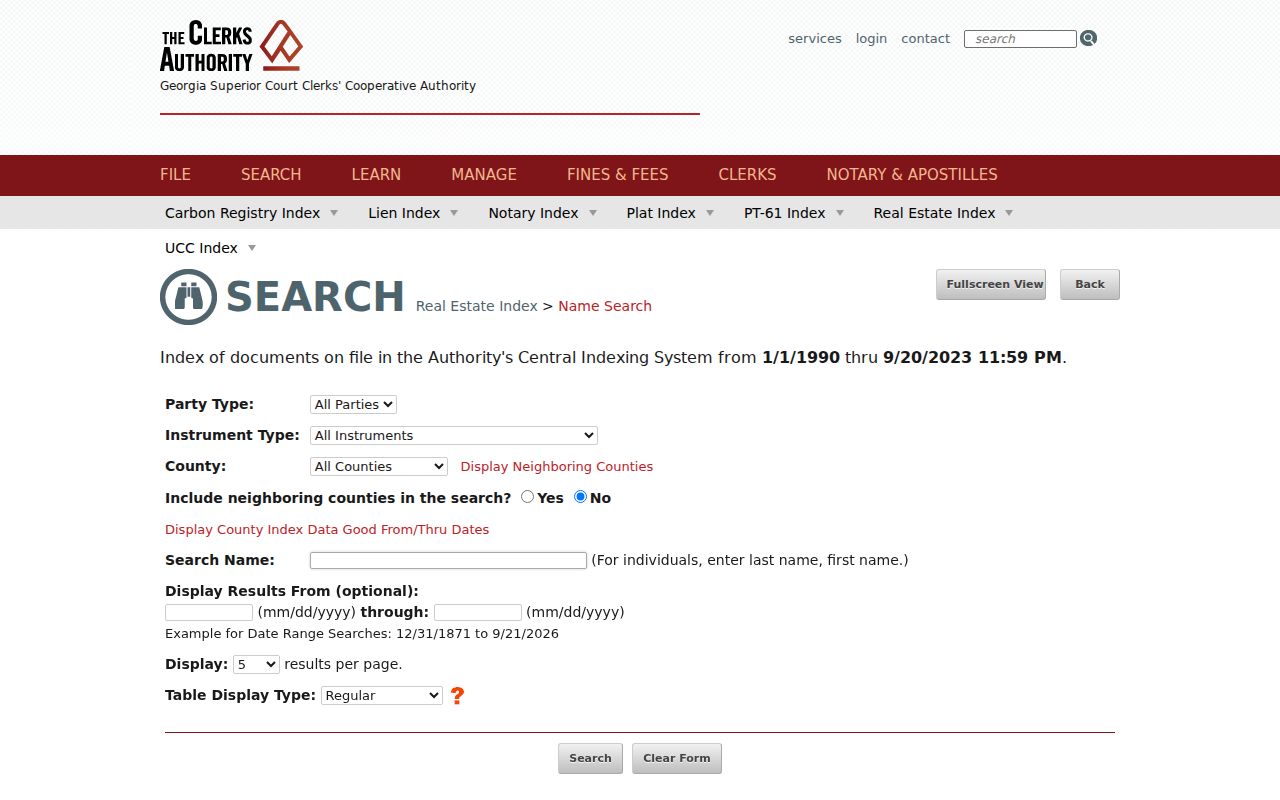
Choose a name variation and county deliberately. Then keep the date range and coverage notice with the search result.
GSCCCA County Dates for Georgia Deed Records
GSCCCA describes a statewide deed-index baseline of at least January 1, 1999. Historical data from 1993-1998 is being added. County-specific "good from/thru" dates and image participation still govern what a search returns. A screen may show a data-vintage date that differs from that baseline. Record the county coverage notice rather than trusting the earliest hit in a broad search. This matters when a buyer, heir, or researcher follows a chain backward. An empty year can mean the county index starts later. The name may have been indexed differently. Or the land once sat in a predecessor county. It does not prove a deed was never made. The county Clerk of Superior Court can point the search to a physical book or local index. For a known citation, the GSCCCA book/page form requires the county, book, and page.
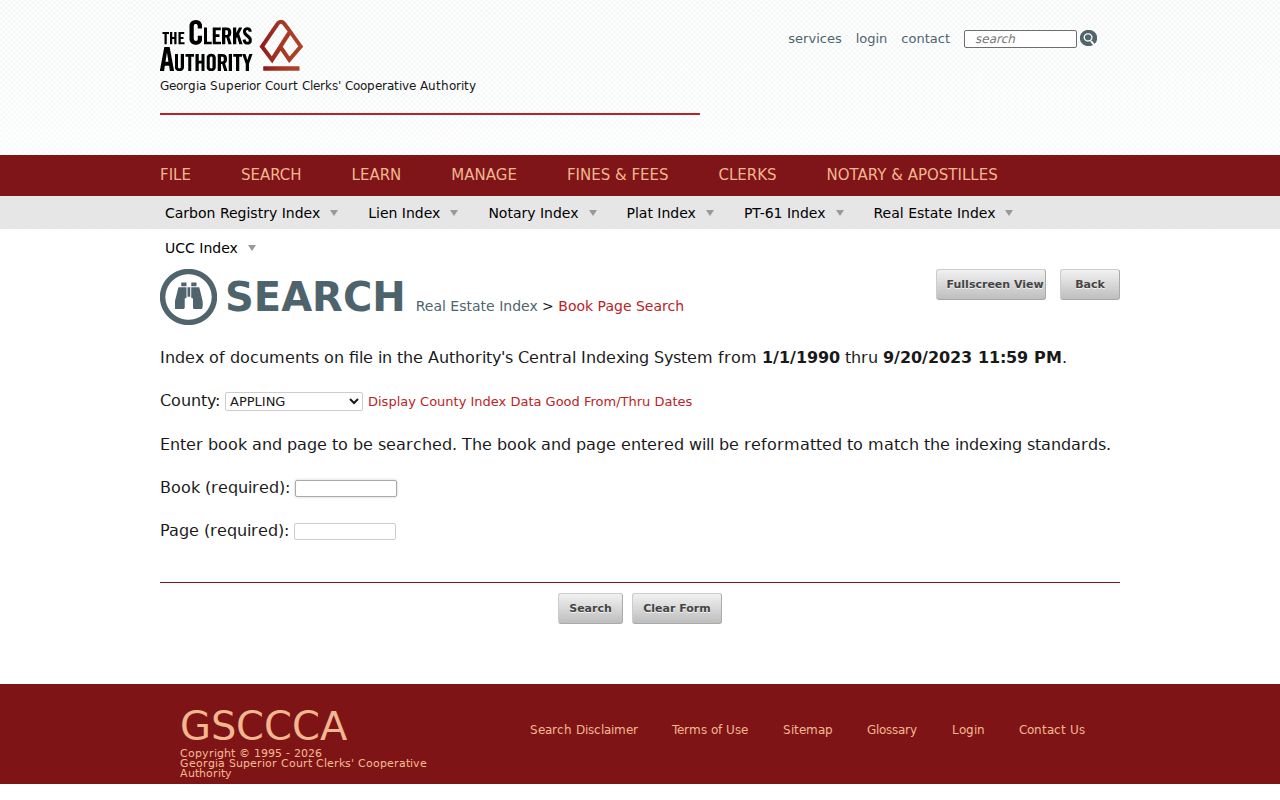
A known county citation can lead back to the index row and then to the recorded instrument image.
Georgia Deed Records: Trace the Grantor Chain
The grantor gives or conveys an interest; the grantee receives it. GSCCCA indexes parties by role. A chain is rebuilt one recorded instrument at a time. Start from a likely recent grantee. Read the deed image and legal description, then search that earlier grantor as a grantee. Match every step to the same land, never just a similar name.
- Search the likely current owner as a grantee in the chosen county and date range.
- Open the matching image and record its grantor, grantee, legal description, date, and book/page.
- Search the prior grantor as an earlier grantee; confirm that the description still matches the parcel.
- Repeat backward, checking entity names, trustee or estate capacity, and predecessor counties where needed.
- When the online run ends, move to local deed books, microfilm, or the Archives catalog.
- Grantor
- The party conveying an interest in an instrument.
- Grantee
- The party receiving an interest in an instrument.
- Chain of title
- The ordered series of recorded instruments used to trace interests in the same land.
- Book and page
- The county record-book location cited by the index; some portals also show an instrument number.
Record the full county citation exactly as displayed. A current parcel ID may not appear in an older book, so carry forward lot and block, district and land lot, adjoining tract, or metes-and-bounds language instead. Classify each instrument first. A deed under power, tax deed, quitclaim, estate transfer, or security deed is not an ordinary sale. A GSCCCA index result is a compact locator. Capture every visible field before leaving the result view, then check the instrument image for what the row does not summarize.
| Parties | Names indexed as grantor and grantee |
|---|---|
| Property | County and location information; subdivision details where available |
| Instrument | Deed or related record category |
| Recorded placement | County deed book and page |
| Date and image | Recording date or range; image access depends on account and participation |
Georgia Deed Records: Image Access
GSCCCA separates index discovery from image access. A limited-use account shows summaries. Single-use access opens a short image window. Regular and premium monthly plans carry different features. Viewing or printing depends on the record and the account level. The cited print charge is $0.50 per page. Check the live account page for current plan terms before opening a long document. An image aids research, but it is not automatically a certified copy. A title transaction, court filing, or other formal purpose may need certification. In that case, request the certified instrument from the county Clerk of Superior Court. The clerk can confirm the current local fee, mail procedure, and accepted citation. Do not assume the statewide index sets a uniform copy price. The GSCCCA account page compares access levels and printing limits.
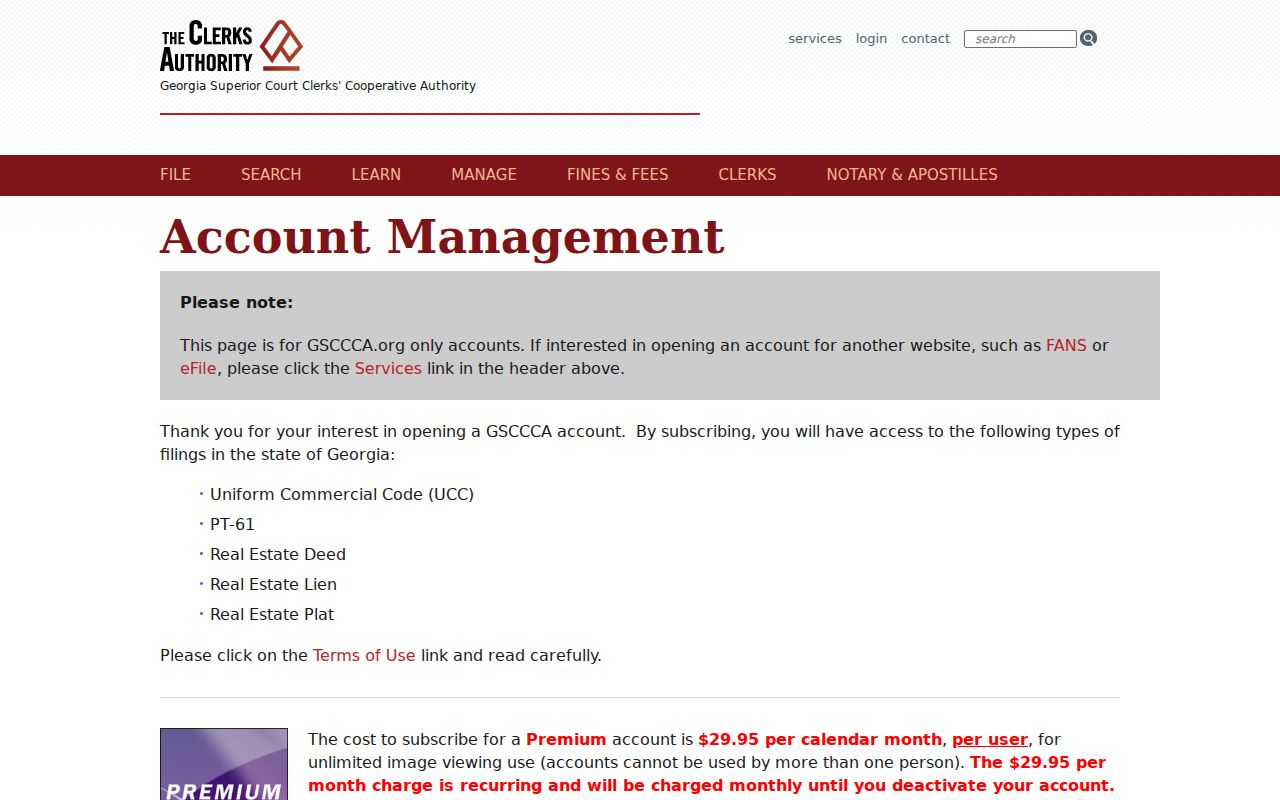
Match the access level to your task. An index summary is never a document copy.
Georgia's Older Deed Books Need Browsing
Georgia's older deeds often live on microfilm. Coverage reaches roughly 1900 for many counties. A parcel's earliest deed may even sit in a predecessor county's books. The Georgia Archives holds county-record microfilm plus research guides and finding aids. That is exactly the kind of digging they support.
FamilySearch collections can be browse-only. A grantor or grantee index sits at the front of the book. There is no modern name search. The pace is slower. But the old pages can expose marginal notes and legal descriptions a current card omits.
Search by county and record type. Note the index volume and year. Carry the legal description from one book entry to the next. An index or book may be missing. Then check a predecessor county, the tax digest, a plat record, a probate file, or a neighboring deed reference. Georgia Archives research help describes the microfilm and FamilySearch routes.
Georgia FANS Watches Selected Filings
GSCCCA's Filing Activity Notification System sends alerts when selected real-estate or personal-property records are filed, indexed, or transmitted and match a user's criteria. Think of each alert as a prompt to inspect a new instrument. FANS does not review a full parcel history or judge whether a filing is valid. It cannot replace a title search. The county clerk remains the record custodian.
After a match, open the document. Compare its county, party roles, instrument type, recording date, and legal description with the parcel. Transmission timing and index coverage vary by county. For a copy or a correction, contact the Clerk of Superior Court using the instrument reference rather than relying on the notification alone. GSCCCA FANS provides signup and service information.
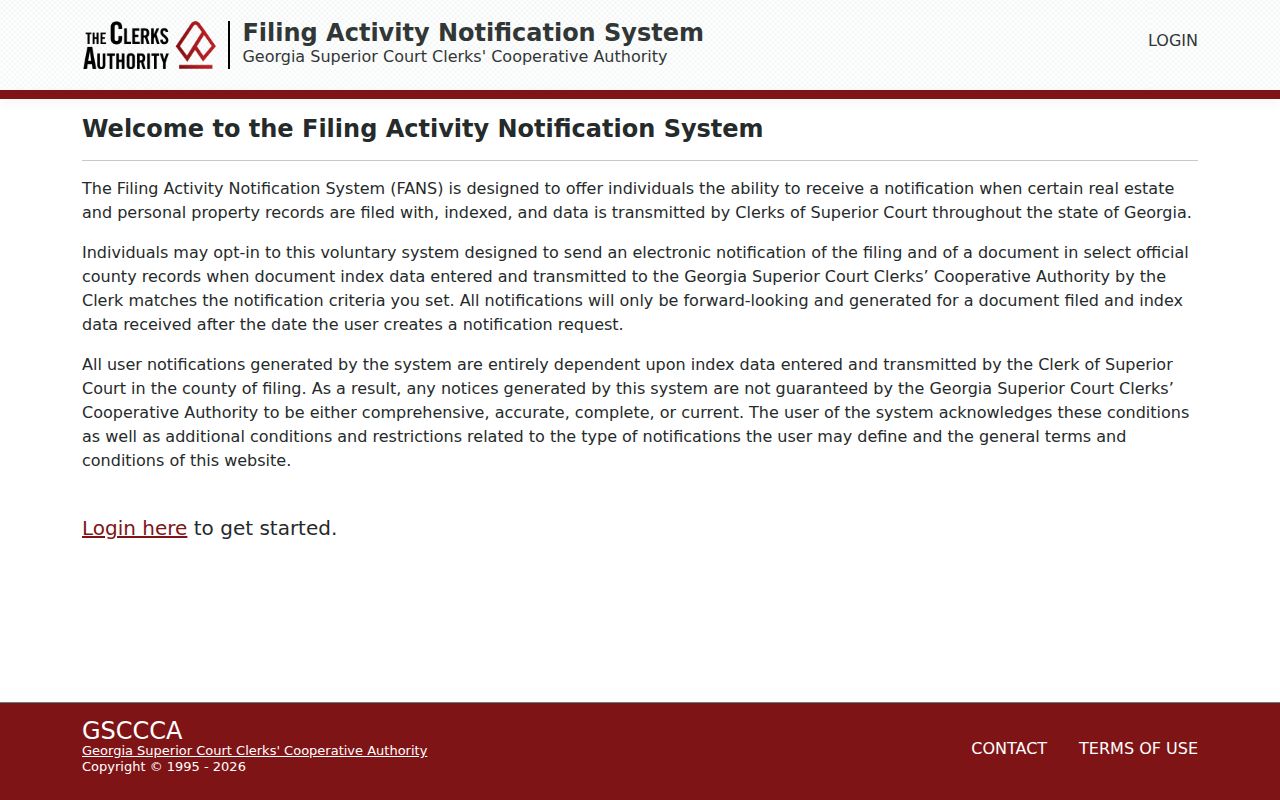
An alert can shorten your wait. Still, a matching notice is neither a title report nor a certified record.
Get a Copy of a Georgia Deed
Start with the GSCCCA result. It gives the county, the parties, the recording date, and the book and page. From there you can decide whether an online image is enough. Or you can decide a certified copy is what you need. The statewide index links to images for participating records, subject to account and print rules. The official record and any certified copy come from the county Clerk of Superior Court. Fees and mail or counter procedures differ by county. So follow the current instructions for the county you select.
No image online? Contact the clerk by phone, mail, email, or in person. A written Open Records Act request can describe an existing recorded instrument. It can do so by party, county, date, book/page, or legal description. The custodian does not have to build a title abstract for you. Putting the request in writing keeps its scope clear. Production may take more than three business days. In that case the agency generally gives an estimated time and cost or cites an exemption.
Watch for unsolicited letters selling a copy of your deed at an inflated price. O.C.G.A. § 10-1-393.15 applies to any real-estate instrument-copy solicitation. It must state prominently that it is not a bill or an official government document. The Attorney General's deed-copy warning advises checking with the county clerk or GSCCCA before paying a mailer. The statutory notice rule spells out the required disclosure language.
Recorded, not guaranteed. Georgia deed records show indexed instruments and recorded images; they are not a title opinion, and unrecorded interests or later corrections may exist. Use a title professional for a complete title determination.