
Tracing Georgia Former Owners
A chain simply strings transfers together for one tract. Log one row per instrument. Check each against the image or the county record. Often the newest grantee on a deed shows up as grantor on an earlier one. Keep the county and legal description beside every entry so a same-name owner or neighboring parcel never slips into your chain.
| Transfer Date | Grantor → Grantee | Deed Type | Book/Page |
|---|---|---|---|
| Date shown on the recorded instrument | Parties named on the newest verified transfer | Copy the instrument label; classify before treating it as a sale | Record the county locator from the index |
| Date on the prior acquisition | Earlier grantor → the grantee now being traced | Confirm from the deed image or clerk record | Record the earlier book/page or document number |
| Repeat for each older link | Search each prior grantor as a grantee | Note estate, security, quitclaim, or other form | Keep the county and locator with the row |
This ledger is only a research aid. It is not a sample title chain, and index entries alone never prove a transfer. GSCCCA index results identify party names, property location, and book/page references, while the county Clerk holds the official instrument and can explain certified copies. Use Georgia's county directory to confirm the jurisdiction before tracing older records.
Georgia Former Owners and the 1999 Index
GSCCCA reports statewide deed-index data reaching back at least to January 1, 1999. Records from 1993 through 1998 are being added. Neither date caps a statewide title chain. Counties send records on their own schedules, and image availability varies. A deed can still sit in a local book. Former owners whose transfers predate a county's indexed range may appear in local books even when a statewide name search finds nothing.
| Source | Years / Coverage | Where Held | What It Shows |
|---|---|---|---|
| GSCCCA deed index | All counties since at least Jan. 1, 1999; historical 1993–98 data are being added; older runs vary by county | GSCCCA index and the county Clerk’s docket | Parties, location, instrument and book/page; check county coverage dates and image access separately |
| County deed and estate books | County-specific; many surviving deed and estate records extend to roughly 1900 on microfilm | Superior Court Clerk, Georgia Archives, or FamilySearch catalog | Recorded transfers, grantor/grantee indexes and estate instruments; older books may need browsing |
| Colonial and Headright Plat Index | Four name volumes compiled 1856–1859, with one later plat entry from 1866 | Georgia Archives Virtual Vault and microfilm | Grantee, acreage, watercourse, survey year and volume/page clues for historic land descriptions |
The live GSCCCA Real Estate Index is built for locating modern chain links through name and book/page searches. Search either way. Its county coverage notice and image availability are separate questions, since index coverage says nothing about scans. The county Clerk remains custodian of the recorded deed.
Walk Georgia Prior Owners Back by Deed
Begin with the newest instrument tied to the parcel. Follow the land description as closely as the names, and before adding any earlier result compare county, parties, date, document type, and legal description.
- Find the latest deed tied to the parcel and note its grantee, grantor, county, date, and book/page.
- Search the deed’s grantor as a grantee in an earlier date range, using the relevant county and neighboring-county option when a boundary shift is possible.
- Open the earlier instrument and compare its legal description with the parcel and later deed.
- Repeat with the earlier grantor; when the online run ends, move to local books or archive copies.
- Grantor
- The party who conveyed an interest in the recorded instrument.
- Grantee
- The party named as receiving that interest.
- Chain of title
- The linked sequence of recorded transfers affecting the same land.
- Direct and reverse indexes
- Older books may separate grantor and grantee entries; check both sides when a name link is unclear.
- Quitclaim vs. warranty deed
- A quitclaim conveys whatever interest the grantor has, if any; a warranty deed includes title promises from the grantor. The label alone does not establish a complete chain.
- Legal description
- Boundary language such as lot and block or metes and bounds; older deeds may lack a modern street address.
Need help locating a single recorded instrument? The Georgia deed records route covers the recorder side while keeping the goal here: joining prior transfers for one parcel.
Check Dates for Georgia Former Owners
Never assume former owners are invisible online. Check the county's "good from/thru" dates first. The GSCCCA notice shows how far that county's index run reaches. Historical additions and image availability do not advance evenly, so a blank result before the displayed start is a coverage gap rather than proof that no deed was recorded. Widen a date range in deliberate steps. A narrow window can manufacture a false break in the chain.
Keep a chain worksheet apart from raw search results. For each candidate link, record the county, parties and their capacities, recording date, instrument label, book/page, legal description, image status, and any prior-deed reference. Predecessor counties matter too. When a record crosses an old county line, add that jurisdiction and compare land descriptions before joining the records. The live GSCCCA name-search form is a discovery route. Read its current county coverage notice, then verify every instrument with the county Clerk.
Georgia Deed Books and Microfilm
Older Georgia ownership often lives beyond online indexes. County deed books, grantor/grantee indexes, tax digests, and plat volumes can push the search back decades. Georgia Archives reports many surviving county deed and estate records on microfilm to roughly 1900. Clerks keep the local record. The Archives and the FamilySearch catalog help locate historical copies. No one year starts every county's books.
The Georgia Archives research guide lays out a browse-first FamilySearch path: Catalog, Georgia, county, then Land and Property. Many collections lack name search. Start at the book index and check both direct and reverse entries. Virtual Vault microfilm offers another route. Archives finding aids and local libraries may point to old newspapers, directories, or plats.
Missing scans are common. Call or visit the county Clerk about the book, year, and copy options, or send a written Open Records request seeking an existing deed image or index by county, parcel description, and date range. No agency must create a title abstract.
Georgia Legal Descriptions Trace Owners
An old deed sometimes has no street address at all. Or it names one that changed long ago. Georgia legal descriptions lean on other markers instead. Look for a lot number, district, land lot, GMD, acreage, an adjoining tract, or a nearby watercourse. Copy the wording exactly. That exact phrasing is what ties one instrument to the next across the decades.
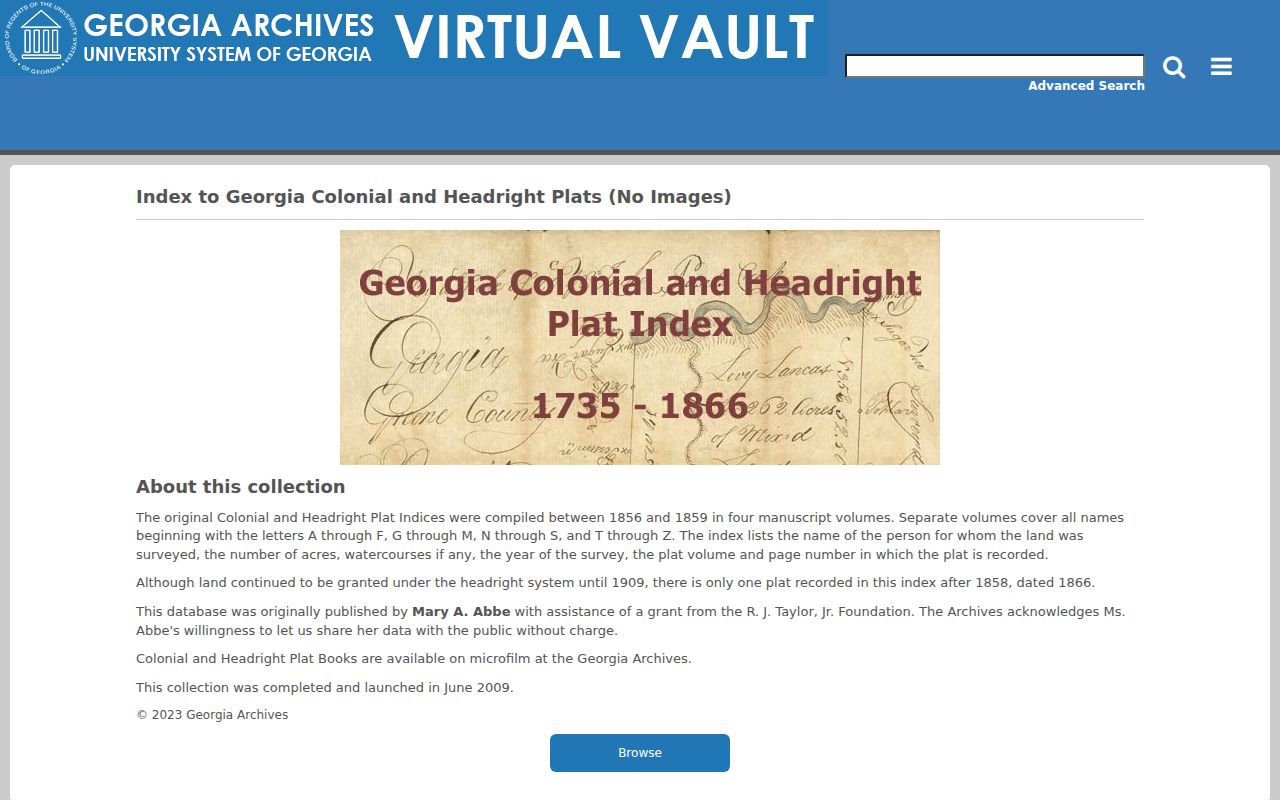
The Georgia Archives makes one useful starting point free. That starting point is the Colonial and Headright Plat Index. Its four name volumes were compiled from 1856 to 1859. Each entry records a grantee, acreage, watercourse, survey year, and a volume and page reference. Land grants under this system ran until 1909. The index holds a single later plat entry, dated 1866. Related colonial plats and warrants can name adjoining landowners. That helps place a tract among its neighbors. Treat those clues as leads, though, since they do not prove modern title.
The Colonial and Headright Plat Index page displays this historic route to a parcel. Take any plat clue from it. Then match that clue against county deed records and the current parcel description.
Old maps explain geography; deeds give the later transfers.
Georgia Probate and Security-Deed Links
An estate transfer can break a clean buyer-to-seller chain. Probate Court papers may name a will, an executor, heirs, an inventory, or an order to sell. Still, a case name alone proves nothing about land. Match the executor's deed or later conveyance against the Clerk's recorded land documents. Only then does the estate connect to a parcel.
The official Georgia Probate Court Information System describes what probate courts handle. Access and fees stay local. Ask the county Probate Court directly about a file. It may sit online, at a terminal index, or in storage. Then tie any estate paper to the deed and its legal description. Marriage records, name changes, trusts, and corporate grantees all reshape the index. They change how an earlier owner of record appears there.
Classify every instrument before calling it a sale. Security deeds, assignments, releases, quitclaims, and deeds under power each carry different weight. For a security deed, look for a recorded cancellation or release. It may also be a satisfaction by the holder or agent. Compare book and page plus the legal description with the original filing. Get title advice when a deal turns on a document's legal effect.
Trace Georgia Former Owners Back
No single statewide end date exists for former-owner research. A chain may run on into deed books, Archives microfilm, a predecessor county, probate records, or tax digests. Georgia Archives holds tax copies beginning about 1872. Earlier material sits on microfilm. A missing volume can leave a gap, since absence from one index never proves a transfer did not occur.
For family or house history, set an old deed beside a tax digest, plat, directory, newspaper notice, or probate file. Keep resident evidence and owner evidence apart. Ask a library or the Archives. Give the county, record type, and year range. When no image is online, the custodian can explain in-person, phone, mail, or written request options plus any local copy charge. The Georgia Open Records Act request guidance explains how to describe an existing public record.
Lawful use. Use former-owner records for property history, estate research, or a land question. Do not use an address or deed trail to track, threaten, or harass a living person; respect protected-address programs such as Georgia Safe at Home.