
Who Owns a Georgia Property?
Ownership has no single statewide card in Georgia. Several offices each hold one part of the record. The route runs from the parcel's physical location, not from a postal city or a map pin. Each handoff between county systems preserves a different piece of the answer about a property.
- Address to county: use the situs address and the Georgia Department of Revenue's county directory to identify the local jurisdiction and official assessor link.
- County to assessor: search the county card by address, then note its owner label, parcel ID, legal description, and separate mailing and situs fields.
- Assessor to deed: use the owner name and parcel description to find the latest recorded conveyance through the statewide deed index, then compare the county and legal description.
This address-to-county-to-assessor-to-deed path answers the question. No single result is final proof of ownership. When the assessor lists an entity, trust, or estate, match the precise name and capacity shown on the deed. The Georgia current property owner record covers reading the present tax-roll entry. Deed copies belong with the recording custodian.
Georgia Property Owner Source Map
Georgia records can name an owner from more than one angle. But they never share an update clock or purpose. A property search needs to know which record to open first. The tax roll shows the current assessment. The county Clerk of Superior Court holds the recorded instrument itself. GSCCCA supplies statewide discovery and links each result back to its county record.
| Where Ownership Appears | What It Gives | How Current |
|---|---|---|
| Assessor roll or property card | Owner label, parcel key, and mailing or situs fields | Use the card's displayed tax year or data date |
| GSCCCA deed index | Recorded parties and the instrument locator | Read the recording date and county coverage notice |
| County Clerk of Superior Court | Official deed image and certified-copy route | Recording office holds the filed instrument |
| County GIS map | Parcel geometry and any linked assessment record | Layer dates and owner links vary locally |
Georgia's GSCCCA Real Estate Index description shows how names, property location, book, and page lead to a filed deed. Discovery is its job. For a sale or title question, the county instrument supplies the record itself. Index summaries, tax cards, and GIS map labels are clues. They must agree on parcel and date.
Georgia Property Address Clues
Georgia property searches run on several kinds of address. The situs address points to the physical parcel. It works best as the key for county selection. A mailing address is simply where tax notices go, and it may be a post-office box, a care-of line, or an out-of-state address. Postal cities and ZIP codes are delivery labels, not proof a parcel sits inside city limits.
Older records complicate things. Compare the full parcel ID and legal description before concluding that two results describe different places. A historic deed may lack a street number. Its road name may have changed. A subdivision, lot and block, district, land lot, or metes-and-bounds description can bridge an older instrument to a present plat or GIS map. Keep the original address text and any shortened search version. A clerk can then see exactly what was checked.
- Owner of record
- The name or entity shown in a public property record; it is not a finding about occupancy or beneficial control.
- Grantee
- The party receiving an interest in a recorded deed.
- Title
- The legal ownership interest established through instruments and applicable law, not a tax-card label alone.
- Situs and mailing
- The physical property location and the separate address used for tax correspondence.
Georgia Entity Names Need Matching
A parcel can sit under an LLC, a corporation, a trustee, or an estate rather than a person's everyday name. Treat the exact assessor name as a lead. Then compare that party and its legal capacity with the deed. Similar entity names alone never connect a person to land. A registered agent receives a business's notices. That role says nothing about owned property.
The tax roll may carry an abbreviated trust name or a fiduciary's name rather than the trust itself. Vesting language on the deed identifies the party receiving the interest and the capacity in which that party acts. Match it to the parcel's county and legal description. The owner-finding route ends there. A detailed reading of an owner field or a recorded deed belongs to the record that holds it.
Georgia Deeds Confirm an Owner Lead
Deeds confirm the lead. The county Clerk of Superior Court records deeds and stays the official custodian. GSCCCA's Real Estate Index provides statewide discovery of grantor and grantee entries, county, instrument, and book-and-page references. Its summary helps locate the document. Images and certified copies come through the available account and county-clerk channels. The index has a broad baseline. Historical additions and image access vary by county.
Always search a name with county and parcel context. A result that fails the legal description never proves a same-name party owns the subject property. Timing matters too. A new deed can be recorded before the tax roll refreshes, so the deed's date can lag the assessor card's data date. The Georgia deed-records page covers index access and copies. Here the deed serves only as the final confirmation step.
Note: Match county, party capacity, parcel description, and recording date before treating a statewide deed-index result as the owner of a specific property.
Georgia Property Owner Searches Vary
Georgia spreads its assessment across 159 county systems. No statewide rule promises that every card is online or labeled the same way. DOR's county property-record directory routes visitors to local property-search systems. Its disclaimer is clear. DOR does not maintain those county sites. The routing page lists the county-specific property-search links.
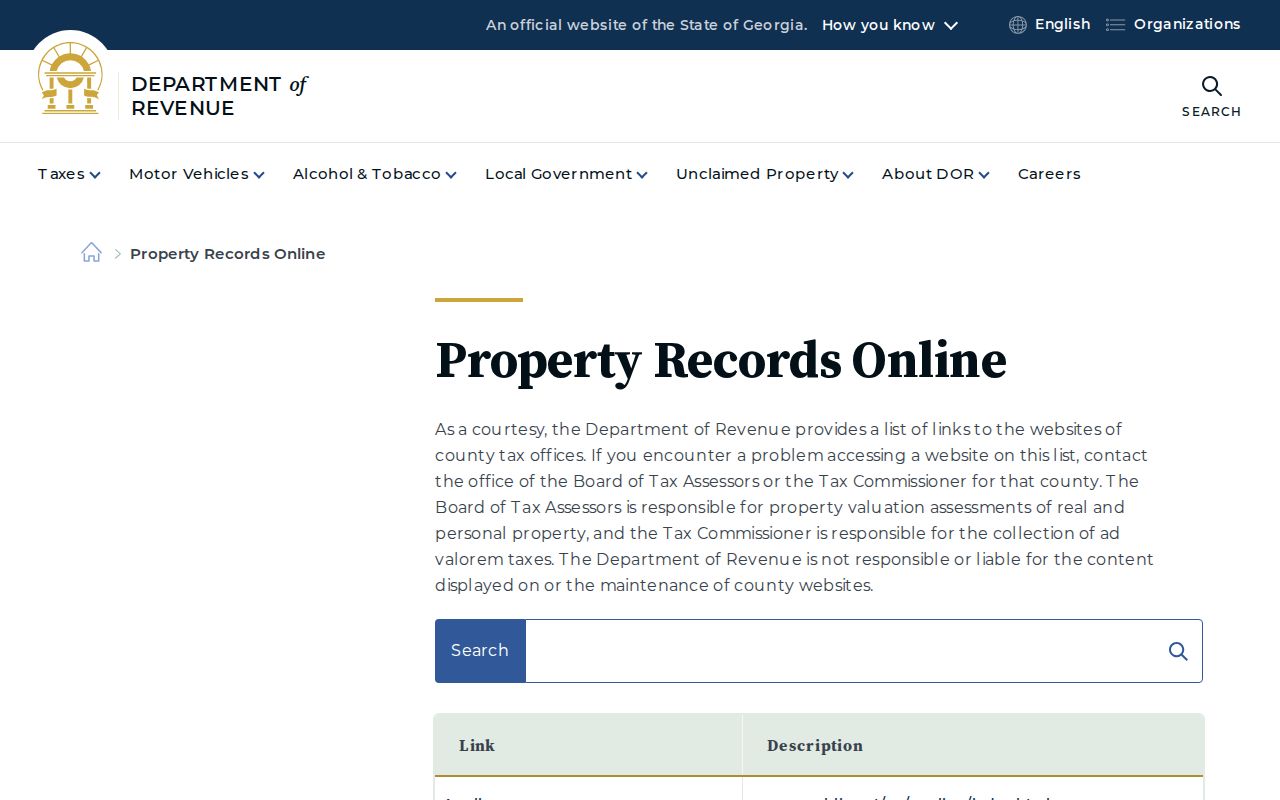
Some counties use a vendor portal; others use a county system or require an office request. A name-search box, parcel key, map link, or printable card may differ from the next county's. Confirm the county and source of the assessor link before relying on the result.
When a county system gives only a map, use the parcel ID to contact the assessor. The same assessor and Tax Commissioner can share a county web page without sharing responsibilities. Do not substitute a commercial profile for a missing assessor card.
Georgia Owner Search by Open Records
No owner field online? Go to the Board of Tax Assessors by phone or at its public counter. Ask for the property card or assessment notice on file. Give the situs address. Include the parcel ID if you have it. Name the tax year you care about. The Clerk of Superior Court can find an existing deed by book and page. It can also search by party name. Address each office for the record it actually holds. Neither will build you a statewide ownership report.
A portal has no download, or the record is unclear. A written request under the Georgia Open Records Act works then. The Georgia Attorney General explains how to make an Open Records request. Name the record, the custodian, the date range, and the format you want. Agencies generally answer within three business days or send an estimate with any exemption cited. They never have to create a new record or analysis for you.
Search and redaction labor is generally free for the first 15 minutes. Copying generally runs up to $0.25 per page under the Attorney General's FAQ. Confirm the current charge with the custodian before you order copies. Send the request by web form, mail, email, or in person. Use the official county contact. No single state directory lists a local number for every Georgia property records office.
Georgia Owner Records Have Limits
A name in the tax roll is not proof of residency. It does not prove who lives at the situs address. The address on a card may be a mailing address, not a residence. Tax-card names can lag behind a newly recorded deed. Same-name people, entity capacity, trusts, and estate names all complicate a match too. An index or tax card is no substitute for a title search. Use these records to find the right custodian. Then obtain the deed or legal review a property transaction demands.
Georgia also limits what owner records can reveal. The Safe at Home and VoteSafe programs shield eligible participants' residence information. Do not try to rebuild a protected address from public fragments. The Secretary of State's Safe at Home program explains address substitution and mail forwarding. Its VoteSafe information covers the voter-address side. A public record never authorizes harassment, stalking, or identity misuse.
Use owner records lawfully. A Georgia owner lookup is for property research and due diligence. It does not verify occupancy or prove title, and owner information must not be used to harass or intimidate anyone.